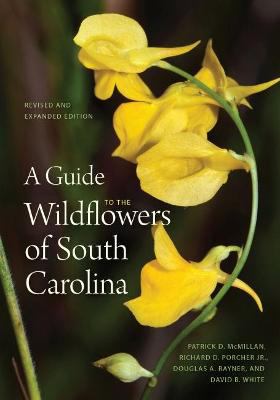
A Guide to the Wildflowers of South Carolina stands as a monumental achievement in regional ecomorphology and spatial botany. It meticulously charts over 2,000 species across South Carolina’s distinct physiographic provinces—stretching from the alpine communities of the Blue Ridge, down through the fractured Piedmont, across the ancient fall-line Sandhills, and into the complex palustrine wetlands of the Coastal Plain.
The authors demonstrate immense technical competence by organizing the flora into precisely defined ecological communities. When navigating its pages during a rigorous hike, you are not simply identifying an isolated flower; you are diagnosing an entire environmental system. The text utilizes highly precise diagnostic descriptions, detailing:
Phyllotaxy and Phenology: Exact leaf arrangements, floral morphology, and highly specific blooming intervals dictated by changing microclimates.
Edaphic Specialization: Microhabitat requirements, including soil pH variances, nutrient availability, and moisture gradients.
Community Co-occurrence: Symbiotic and competitive associations within highly specialized niches like pocosins, granite outcrops, basic glades, and maritime forests.
By grounding their keys in community ecology, the authors honestly confront a difficult reality of modern field botany: ecosystems are dynamic, overlapping continuums, not static boxes. How can a printed text capture this environmental fluidity? It does so by using plant associations as living indicators of landscape history and human-driven ecological succession.
Instructional Guide for the Field Naturalist
To maximize the utility of this massive volume during field research or backcountry excursions, do not treat it as a passive dictionary. Instead, execute the following interpretive sequence:
Delineate the Physiographic Province: Before examining the specimen’s macroscopic features, establish your exact geographic and geological coordinates on the state’s structural map.
Appraise the Local Plant Community: Analyze the surrounding canopy, understory matrix, and hydrological patterns. Are you standing in a fire-maintained, well-drained longleaf pine savanna, or a saturated blackwater floodplain?
Deploy the Community-Specific Key: Locate the corresponding chapter in the text. This narrows your taxonomic possibilities by up to 80%, drastically reducing the diagnostic errors common when using generalized, nationwide keys.
This work is an uncompromising, reliable standard for naturalists, resource managers, and environmental historians alike. It honors both the immense complexity of the southeastern landscape and the intellectual capacity of the reader.
Reviews
There are no reviews yet.